Structural barriers and policy pathways for a just clean energy transition

Keyword(s)
Author(s)
Hannah Hoehnke, Moritz Wussow, Chad Zanocco, Sanya Carley, David Konisky & Dirk Neumann
Country(ies)
Publisher
Published Date
Access
DOI
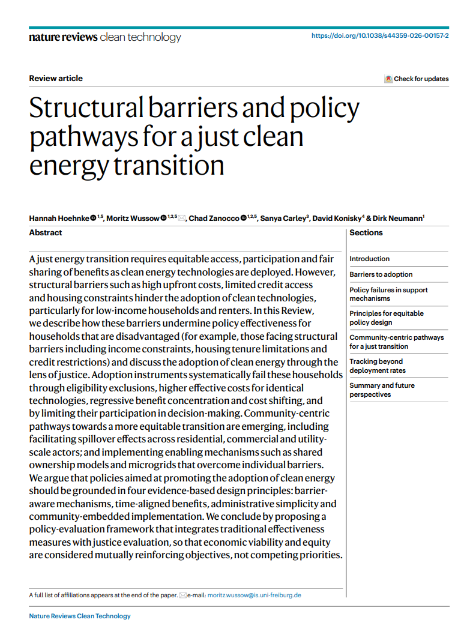
A just energy transition requires equitable access, participation and fair sharing of benefits as clean energy technologies are deployed. However, structural barriers such as high upfront costs, limited credit access and housing constraints hinder the adoption of clean technologies, particularly for low-income households and renters. In this Review, we describe how these barriers undermine policy effectiveness for households that are disadvantaged (for example, those facing structural barriers including income constraints, housing tenure limitations and credit restrictions) and discuss the adoption of clean energy through the lens of justice. Adoption instruments systematically fail these households through eligibility exclusions, higher effective costs for identical technologies, regressive benefit concentration and cost shifting, and by limiting their participation in decision-making. Community-centric pathways towards a more equitable transition are emerging, including facilitating spillover effects across residential, commercial and utility-scale actors; and implementing enabling mechanisms such as shared ownership models and microgrids that overcome individual barriers. We argue that policies aimed at promoting the adoption of clean energy should be grounded in four evidence-based design principles: barrier-aware mechanisms, time-aligned benefits, administrative simplicity and community-embedded implementation. We conclude by proposing a policy-evaluation framework that integrates traditional effectiveness measures with justice evaluation, so that economic viability and equity are considered mutually reinforcing objectives, not competing priorities.