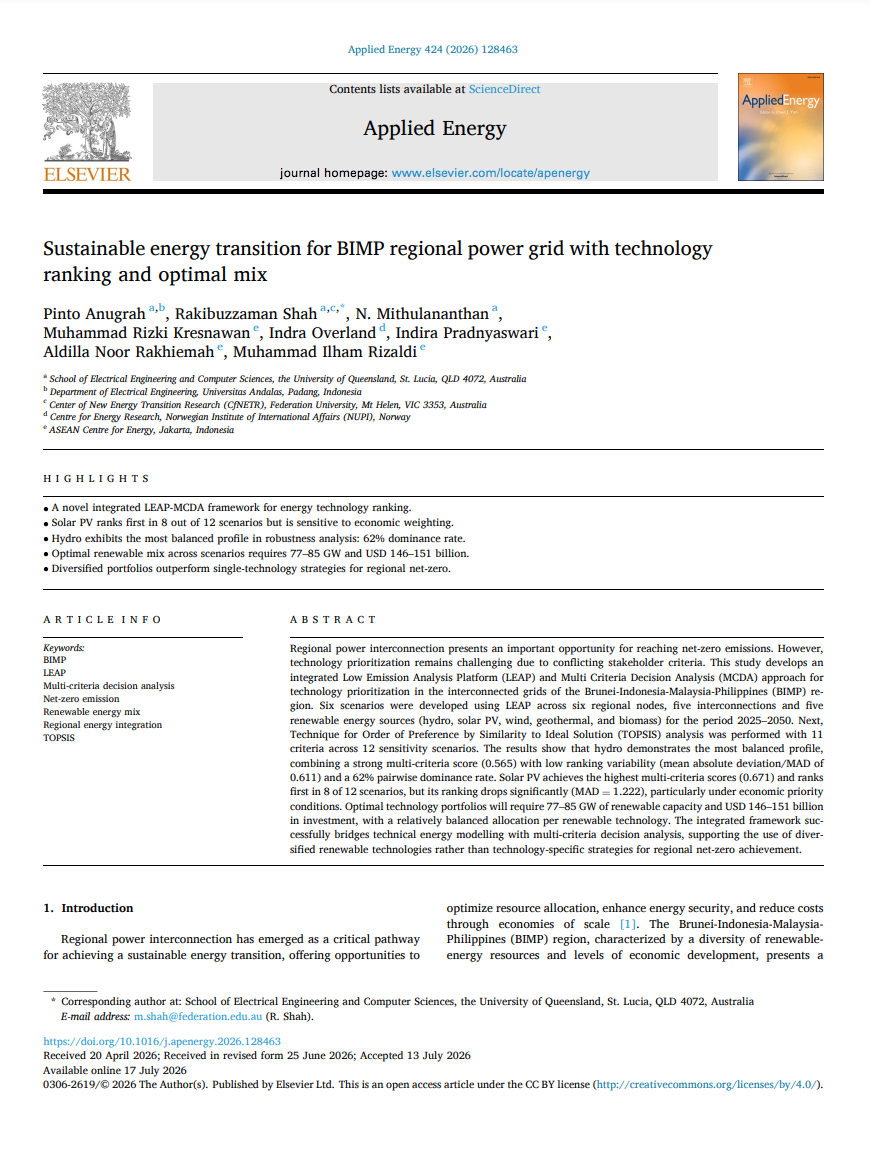
Sustainable energy transition for BIMP regional power grid with technology ranking and optimal mix

Category
Tag
BIMP, Regional energy integration, Renewable energy mix, LEAP, Net-zero emission
Project
Author
Pinto Anugrah, Rakibuzzaman Shah, N. Mithulananthan, Muhammad Rizki Kresnawan, Indra Overland, Indira Pradnyaswari, Aldilla Noor Rakhiemah, Muhammad Ilham Rizaldi
Regional power interconnection presents an important opportunity for reaching net-zero emissions. However, technology prioritization remains challenging due to conflicting stakeholder criteria. This study develops an integrated Low Emission Analysis Platform (LEAP) and Multi Criteria Decision Analysis (MCDA) approach for technology prioritization in the interconnected grids of the Brunei-Indonesia-Malaysia-Philippines (BIMP) region. Six scenarios were developed using LEAP across six regional nodes, five interconnections and five renewable energy sources (hydro, solar PV, wind, geothermal, and biomass) for the period 2025–2050. Next, Technique for Order of Preference by Similarity to Ideal Solution (TOPSIS) analysis was performed with 11 criteria across 12 sensitivity scenarios. The results show that hydro demonstrates the most balanced profile, combining a strong multi-criteria score (0.565) with low ranking variability (mean absolute deviation/MAD of 0.611) and a 62% pairwise dominance rate. Solar PV achieves the highest multi-criteria scores (0.671) and ranks first in 8 of 12 scenarios, but its ranking drops significantly (MAD = 1.222), particularly under economic priority conditions. Optimal technology portfolios will require 77–85 GW of renewable capacity and USD 146–151 billion in investment, with a relatively balanced allocation per renewable technology. The integrated framework successfully bridges technical energy modelling with multi-criteria decision analysis, supporting the use of diversified renewable technologies rather than technology-specific strategies for regional net-zero achievement.
This article is published at DOI https://doi.org/10.1016/j.apenergy.2026.128463