Aligning NDCs and Energy Plans: ACE and ACCEPT Share ASEAN Evidence at the 1st Asia ACT Forum

Manila, 9th October 2026
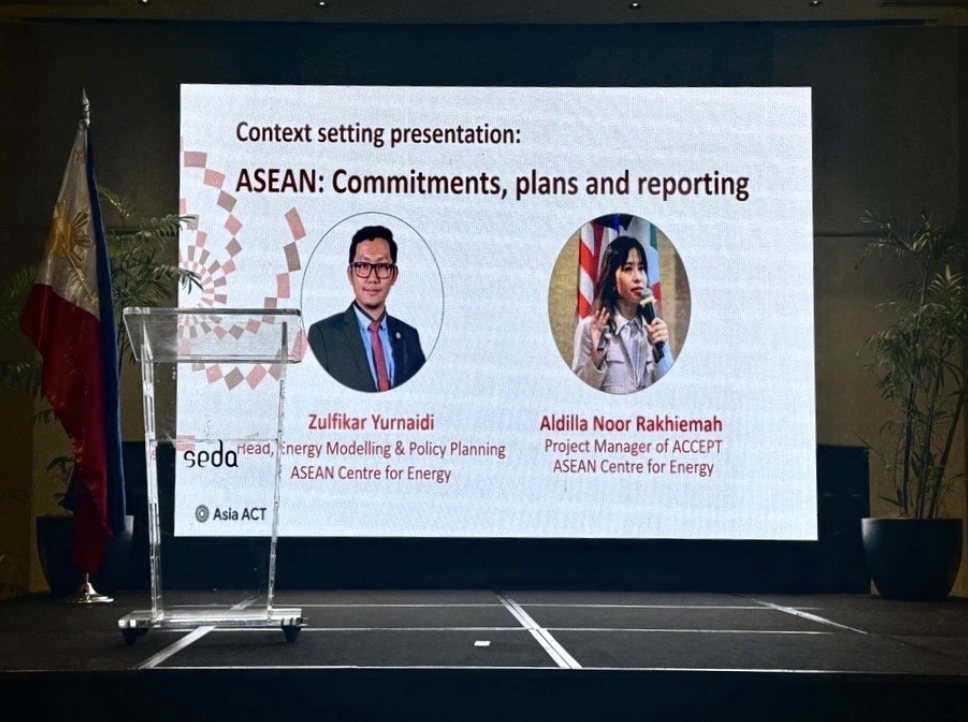
Photo 1. Context setting presentation by Dr Zulfikar Yurnaidi, Head of Energy Modelling and Policy Planning at the ASEAN Centre for Energy and Aldilla Noor Rakhiemah, Project Manager of the ASEAN Climate Change and Energy Project (ACCEPT) at the ASEAN Centre for Energy.
Manila, 9th October 2026 – The ASEAN Centre for Energy (ACE), through the ASEAN Climate Change and Energy Project (ACCEPT), took part in the first Accelerating Clean Transitions in Asia Forum (Asia ACT Forum), held in Manila, the Philippines. Led by the UNFCCC through its Regional Collaboration Center for Asia and the Pacific (RCC Asia-Pacific) and hosted by the Philippines’ Climate Change Commission (CCC) and the Department of Energy (DoE). The ACT Forum is delivered under the Philippines’ ASEAN Chairship and brought together UN Framework Convention on Climate Change (UNFCCC) focal points responsible for Nationally Determined Contributions (NDCs) and Biennial Transparency Reports (BTRs) with energy focal points who lead national energy transitions with the aim to support NDC implementation and link policy, finance, and implementation to accelerate clean energy transitions in the region. ACE and ACCEPT contributed to Session 2, “ASEAN’s Energy Transition: From Commitment to Delivery”, sharing insights on the region’s energy transition.
Session 2 of the ACT Forum is designed to build a common evidence base on the clean energy transition across ASEAN and to support structured country dialogue on where NDC commitments, national energy policies, and implementation stand today. It drew on the foundations ASEAN Member States (AMS) have already built, including targets in their NDCs and national power development plans, and the ASEAN Plan of Action for Energy Cooperation (APAEC) 2026–2030. Eight ASEAN Member States have announced net-zero or carbon neutrality targets, and eight had submitted their third-cycle NDCs by September 2026.
The second context-setting presentation of the second session, on commitments, plans, and reporting, was delivered by Dr Zulfikar Yurnaidi, Head of Energy Modelling and Policy Planning at ACE. Dr Zulfikar presented the key findings of the 9th ASEAN Energy Outlook (AEO9), endorsed by AMEM, which projects the region’s energy system to 2060. The Outlook explores three scenarios: a Baseline Scenario (BAS) reflecting current national trajectories, an AMS Target Scenario (ATS) reflecting stated national policies and targets, and an ASEAN Coordinated Transition Scenario (ACTS), a regionally optimised pathway in which Member States strengthen coordination on electricity trade, energy efficiency, technology, and investment.
Aldilla Noor Rakhiemah, Project Manager of ACCEPT, followed with a presentation on ASEAN’s energy-climate commitments. Ms Aldilla explained how APAEC 2026–2030 serves as the guiding framework and walked through the energy-climate targets of all ASEAN Member States, comparing their latest NDC overall targets, energy sector targets, national energy policy targets, and installed renewable energy capacity. The comparison showed the varying targets that AMS have stated in their NDCs.
Turning from targets to action, Ms Aldilla underscored the gap from targets to action. Ms Aldilla outlined five ways to close the gap on the road to the next COP: connecting climate and energy planning, making progress measurable by clearly distinguishing emissions, installed capacity, and generation targets, turning targets into funded action, using regional cooperation to enable delivery, including through the ASEAN Power Grid, and ensuring a just and inclusive transition. Furthermore, Ms.Aldilla also highlighted the financing challenge as global energy investment is nearing USD 3.4 trillion in 2026, yet ASEAN captures only 3% to 4% of it despite accounting for 5% of global energy demand and 9% of the global population, while the AEO9 estimates that the accelerated transition pathway requires USD 6.4 trillion more investment by 2060 than the baseline.
After the presentations, the session moved into interactive country roundtables, divided into two blocks, the first block looked at where commitments, plans, and delivery diverge and why. The second block turned to what has worked. The session closed with key messages and the way forward from Julie Amoroso-Garbin, Regional Lead at UNFCCC RCC Asia-Pacific.
By bringing regional modelling evidence, a comparison of Member States’ commitments, and country-level dialogue into a single session, the discussion supported the Forum’s aim of linking climate commitments, energy policy, and implementation on the ground. It also contributes regional evidence and lessons that can inform future BTRs, the 2028 Global Stocktake, and the next NDC cycle, as ASEAN moves from setting targets to delivering them.
** Join our ASEAN Researchers Network on Climate Change (ARNECC) by registering yourself here. Become a part of our collaborative efforts to address pressing climate challenges and shape a sustainable future.
Detailed information on ACCEPT II can be found at https://accept.aseanenergy.org/
Follow our social media to stay updated on ASEAN’s energy-climate nexus and ACCEPT activities.