
Jakarta, 28 September 2026
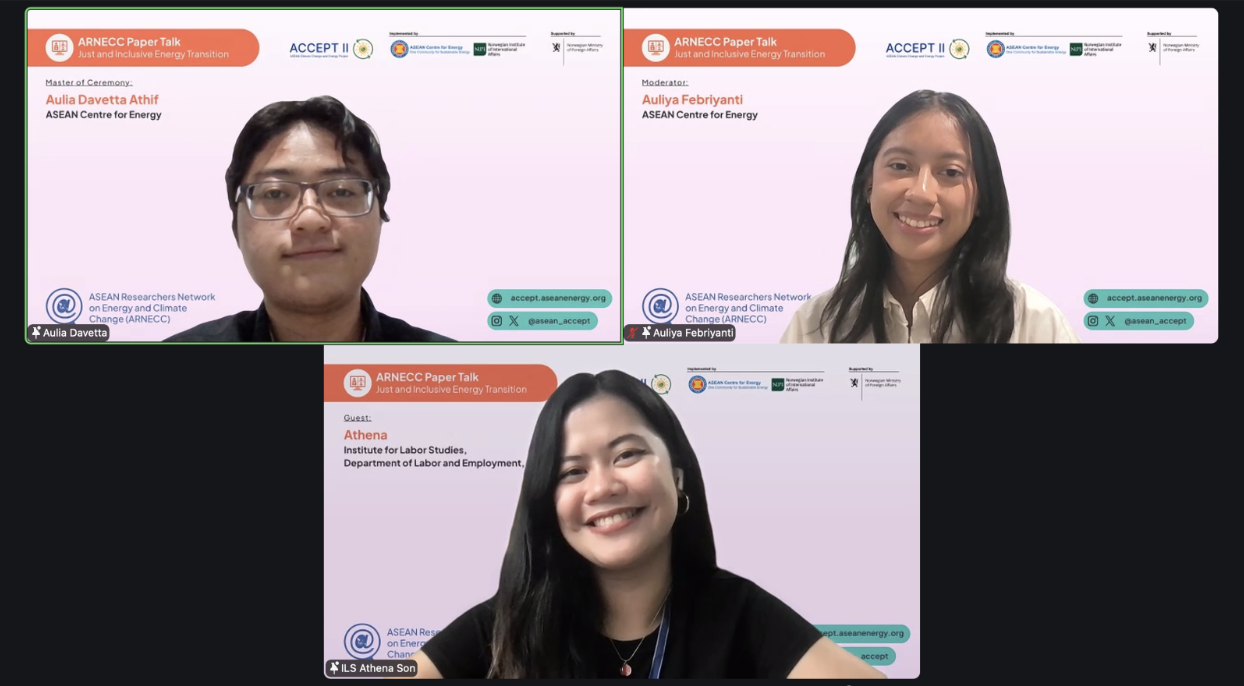
Photo 1. (left to right) Aulia Davetta Athif, Research Assistant for ACCEPT II, Ms. Auliya Febriyanti, Junior Research Analyst at the ASEAN Centre for Energy, and Athena Mari, Supervising Labor and Employment Officer.
Jakarta, 24 September 2026 – The ASEAN Climate Change and Energy Project (ACCEPT) through the ASEAN Researchers Network on Energy and Climate Change (ARNECC) held the sixth episode of ARNECC Live Podcast in 2026 on the series of Just and Inclusive Energy Transition (JIET). In the latest episode, on the topic of “Green Jobs and the Just and Inclusive Energy Transition” ACCEPT II invited Ms. Athena, Supervising Labor and Employment Officer in the Employment Research Division of the Institute for Labor Studies, Philippine Department of Labor and Employment (DOLE), to discuss emerging energy workforce opportunities, challenges from the labour perspective, and how ASEAN can better prepare its people to participate in the energy transition and ensure that it is just and inclusive.
The live podcast was opened by Aulia Davetta Athif, Research Assistant for ACCEPT II as Master of Ceremony, and moderated by Auliya Febriyanti, Junior Research Analyst at the ASEAN Centre for Energy.
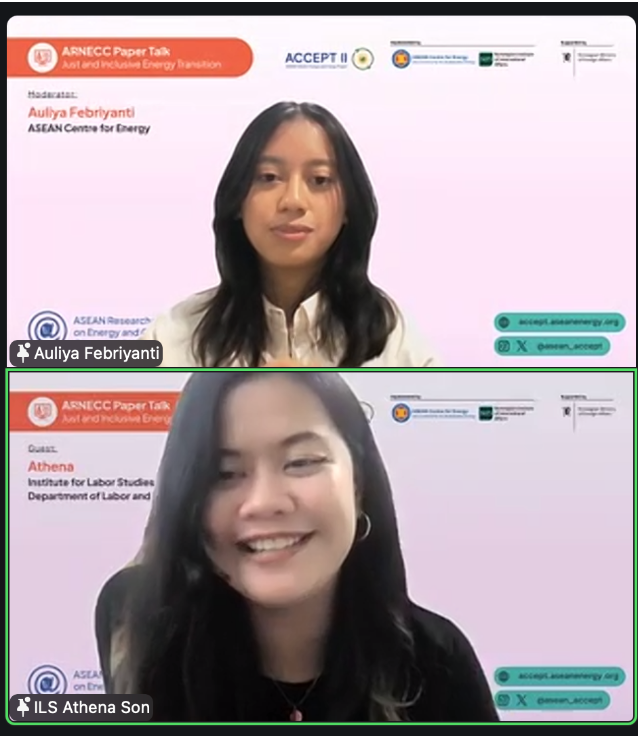
Photo 2. Ms. Athena Mari explaining the Institute of Labor Studies.
The session began with an introduction to the Institute for Labor Studies (ILS), an agency attached to the Philippines’ Department of Labor and Employment (DOLE). ILS was presented as a leading institution specialising in labour and employment research, providing research and technical services to support evidence-based policymaking throughout the policy development process. Its work covers key areas of decent work, including employment, labour rights, social protection, and just transition. Research findings are developed through policy studies, field engagement with workers and employers, and policy briefs, with the aim of informing government strategies and strengthening good governance within the labour and employment sector.
Turning the discussion on how the Philippines turns its roadmaps into action, Ms. Athena emphasised the principle of responsiveness in policy implementation. She addressed that implementation does not rest with the ministry alone, responsibilities for advancing green jobs are shared across government agencies. She also highlighted that a green job is not defined solely by its contribution to environmental objectives but must also provide decent and quality employment. Central to the approach is social dialogue: a participatory, whole-of-society process that goes beyond a tripartite arrangement to involve employers, labour groups, and civil society, moving from policy to plan to specific programmes rather than following a top-down approach.
Turning to the discussion on challenges facing marginalised and rural areas, Ms. Athena identified three main barriers. The first is skills, as the labour supply coming out of education and training does not yet match what a green economy demands. Modules are being developed for youth and other groups, but stronger engagement between education, industry, and government is still needed. The second is the uneven capacity of stakeholders, as many agencies are involved in green jobs but differ in their understanding of the concept, leading ILS to keep reiterating what green jobs actually mean. The third is an awareness gap, including among stakeholders who are not yet prepared to respond to the evolving conversation.
Against this broader workforce development context, the discussion then turned to whether local communities are directly benefiting from the expansion of renewable energy. Drawing on ILS research, Ms. Athena shared findings from ILS research covering renewable energy companies working in biomass, wind, solar, and geothermal, where most of these companies hire locally, so nearby communities do benefit, but renewable energy is not a labour-intensive sector. Local labour demand peaks during the construction phase and tapers off in the operational phase as specialist roles required to operate the projects afterwards remain niche and are often filled by workers from outside the area.
The second half of the discussion focused on answering questions from the audience. The first question asked how the priority sectors for the just transition roadmaps were selected. Ms. Athena explained that six sectors were prioritised because they are already undergoing significant sustainability transitions: renewable energy, transport, eco-tourism, manufacturing, construction, and agriculture. In the transport sector, for example, attention is being given to modernisation, emissions reduction, and alignment with national NDC targets. However, she shared that implementation remains complex because each sector requires targeted approaches.
A related question asked what businesses should do to ensure their own energy transition is just. Ms. Athena said the private sector has a major role to play and that conversations with employers point to the need for incentives for firms that train their workforce in green skills, as well as support for research and development on sustainability and green technology. As an example, she cited the Employers Confederation of the Philippines and labour organisations that released a bipartite manifesto and established a bipartite committee on the issue of a just transition. This committee later held dialogues with their members on why a just and inclusive transition matters for the environment and the economy.
As the session concluded, the way forward for the region is to make sure that green jobs must be more than a label and must translate into decent, quality work that reaches workers in every region and sector. Social dialogue among governments, employers, labour groups, and civil society will be essential to ensure that the transition is planned with workers rather than for them. With the energy transition accelerating, the discussion made the case that participatory planning and inclusive dialogue is the surest way to keep no worker behind.
** Join our ASEAN Researchers Network on Climate Change (ARNECC) by registering yourself here. Become a part of our collaborative efforts to address pressing climate challenges and shape a sustainable future.
Detailed information on ACCEPT II can be found at https://accept.aseanenergy.org/
Follow our social media to stay updated on ASEAN’s energy-climate nexus and ACCEPT activities.